DL-CBR
Bringing deep feature learning to case-based reasoning.
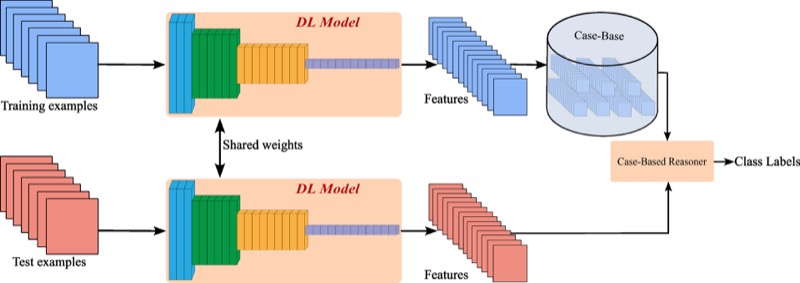
Deep networks supply the indexing features a case-based reasoner uses to retrieve and compare cases.
Case-based reasoning solves a new problem by retrieving similar past cases, which makes it only as good as the features it uses to judge similarity. This line of work, with the Leake group at Indiana University, asks how deep neural networks can supply those features — and what changes when the network is trained with retrieval, rather than classification, in mind.
The first step was diagnostic: which network architectures actually produce useful features for case-based classification? Comparing several models showed that feature quality is not a fixed property of a network but depends jointly on its design and on how much data is available to train it — so the right backbone for a case-based system is a deliberate choice, not a default.
Given that architecture matters, the next question was how to get strong features when data is scarce. Here transfer learning proved decisive: features from pretrained deep models were more reliable for case retrieval than features from models trained from scratch, and the resulting case-based classifier outperformed comparable end-to-end deep baselines in limited-data settings.
The most recent work closes the loop by changing the training objective itself. Rather than borrowing features from a network trained only to classify, we guide training with proxy objectives that reflect how case-based systems actually compare examples. Across several image datasets, features learned this way yield stronger case-based classification than conventional end-to-end models — features shaped for retrieval, not merely inherited from it.