← All projects

GC-MVSNet

Making geometric consistency an explicit training signal for multi-view stereo.
3D ReconstructionMulti-View StereoDepth Estimation
Code
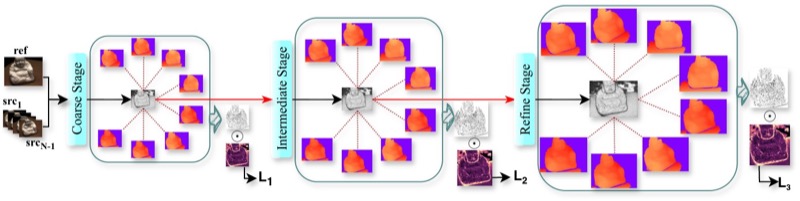
Our multi-view, multi-scale geometric consistency checking process. During training, the geometric consistency of the estimated depth map is explicitly modeled across multiple source views. This allows the model to more quickly and accurately learn about geometric consistency, allowing the trained model to produce better reconstructions during inference.

Our multi-view, multi-scale geometric consistency checking process. During training, the geometric consistency of the estimated depth map is explicitly modeled across multiple source views. This allows the model to more quickly and accurately learn about geometric consistency, allowing the trained model to produce better reconstructions during inference.

Most multi-view stereo networks supervise each view’s depth map on its own, leaving the network to discover cross-view geometric consistency only implicitly — if at all. GC-MVSNet makes that consistency an explicit part of training.

During learning, the model checks each pixel’s predicted depth against the geometry implied by several other views at once, across multiple scales, and penalizes predictions that disagree. Instead of hoping consistency emerges, the network is pushed toward depths that hold up everywhere. The result is faster convergence and sharper reconstructions, and the mechanism drops into existing MVS pipelines without redesigning them.

The journal extension, GC-MVSNet++, develops the idea further and studies where geometric supervision helps most.


Related publications

Deep learning-based 3D reconstruction from multiple images: A survey
2024
Chuhua Wang, Md. Alimoor Reza, Vibhas Kumar Vats, Yingnan Ju, Nikhil Thakurdesai, Yuchen Wang, David Crandall, Soon-heung Jung, Jeongil Seo • Neurocomputing
This survey presents an overview of deep learning approaches for 3D reconstruction. It groups existing work into major problem settings and compares methods based on their architecture, outputs, datasets, and quantitative results. The paper also highlights current challenges and promising directions for future research.
Survey3D ReconstructionMulti-View Stereo
BibTeX DOI Paper
GC-MVSNet: Multi-View, Multi-Scale, Geometrically-Consistent Multi-View Stereo
2024
Vibhas Vats, Sripad Joshi, David Crandall, Md. Alimoor Reza, Soon-heung Jung • WACV
GC-MVSnet explicitly models geomtric consistency constraints across different views to acceralte optimization and geometric understanding of learning-based models. We produce state-of-the-art results on DTU, BlendedMVS, and Tanks & Temples datasets.
3D ReconstructionMulti-View Stereo
Project PDF arXiv Code BibTeX Video Supplement Journal Version
Blending 3D geometry and machine learning for multi-view stereopsis
2025
Vibhas Vats, Md. Alimoor Reza, David Crandall, Soon-heung Jung • Neurocomputing
GC-MVSNet++ improves the reconstruction quality of 3D scenes by introducing a novel cost-regularization network based on the principles of dense-connnections. It produces competitive results to state-of-the-art MVSFormer++ paper without using Transformers.
3D ReconstructionMulti-View Stereo
arXiv Code BibTeX DOI Paper